
“Peculiarly Compulsive:” ON KEEPING A NOTEBOOK (To Borrow a Title & a Phrase from Joan Didion)
Is analog the answer to the ways in which the “attention economy” has massacred our memory? Has a dozen-year career in journaling made me a better or a worse writer, teacher, person?

In “On Keeping A Notebook,” Joan Didion sets a scene for her reader: two women at opposite ends of a hotel bar across the street from the Pennsylvania Railroad terminal in Wilmington, Delaware, one in a “dirty crepe-de-Chine wrapper” and the other in a “plaid silk dress from Peck & Peck [with] the hem coming town.” These women, lurid in their untidiness, are bemoaning romantic complications to the bartender and their companion, respectively, and seem to have something crucial in common––or, at least, this is what Didion imagines on their behalf. This scene is set, in fact, upon nothing more than a few scribbles Didion finds in an old notebook: “Dirty crepe-de-Chine wrapper, hotel bar, Wilmington RR, 9:45 a.m., August Monday morning.” From Didion’s notes, it’s not clear that these women have any inner lives at all, let alone something serious to share: any depth or commonality is merely Didion’s projection.
“Why did I write it down?” Didion says of this somewhat sordid, certainly obscure tableau. “In order to remember, of course, but exactly what was it I wanted to remember? How much of it actually happened? Did any of it? Why do I keep a notebook at all? It is easy to deceive oneself on all those scores. The impulse to write things down is a peculiarly compulsive one, inexplicable to those who do not share it, useful only accidentally, only secondarily, in the way that any compulsion tries to justify itself.”
Didion concludes the preface to Slouching Towards Bethlehem, the essay collection in which “On Keeping A Notebook” appears, with a word of caution: “One last thing to remember: writers are always selling somebody out.” Didion is speaking, here, as a writer who was every bit a journalist as she was a novelist: in other words, an eavesdropper, a lurker, a vulture. A writer mines details like a magpie; a writer appropriates; a writer sells people out. What, then, can be said of the writer’s––of Didion’s––ethical status? And, at the heart of it, does this question even matter? In some ways this is a classic undergrad-at-Kenyon College English-seminar formulation: is it foundationally wrong for Didion to borrow glancing particulars from the lives of strangers, and then to cohere them into a distinct narrative of her own? Or is it simply how she’s made? What does the satisfied consumption of these “sold-out” or appropriated details mean for the reader, and our own precious “ethical status?”
Like Didion, I am a “peculiarly compulsive” notebook-keeper. For me, this identity seems like a genetic inheritance. I am the product of a marriage of scribes: throughout my childhood, I witnessed both my mother and my father scribbling away in various notebooks as if their lives, and ours as a family, depended on it. To this day, my mother, an inveterate creative, hustler, and small-business owner, is practically powered by paper: her formidable inches-thick three-ring binder (featuring, naturally, a charming floral-print cover) contains a record of every appointment, commitment, shopping list, and flight number––a proper externalization of her brain. I remember my father compiling similar mundane data in pocket-sized manila notebooks that he ordered in bulk and kept in the drawer of the credenza nearest the front door of my childhood home. Even in the late nineties/early aughts, even as a very young child, I conceived of these as seriously retro, as utile fossils; I also remember that these booklets were especially elemental to my dad’s role as a lay-leader in his church (he counted the offerings from the plate every Sunday after service, and I think did some unofficial financial planning/advising for the parish) which was, to the retrospective eye, a position that brought him an almost singular peace, purpose, and dignity. So, indeed, the scriptive habits of my household were necessitous, both for livelihood and for identity. The “peculiar compulsion,” here, justifies itself.
Naturally, then, I have grown up into a similarly-habitual recorder. In lieu of my parents’ bulging binders and ossified blotters, I maintain four separate notebooks all at once, which are:
A scruffy spiral-bound college-ruled notebook, given as a freebie by the Loyola University School of Education upon my convocation. This book is helpfully demarcated by multicolored cardboard dividers, which allows me to separate my class notes for each of my graduate courses from the section I use for notes relevant to my day job. As you’ll see in the picture, when it comes to the notes I take on my readings, I basically adhere to the Cornell-notes style, which is completely by accident, but it works for me.
A hardcover, butter-yellow journal in which I do my daily meditation and excavation. Although I have been a devout journaler for the better part of a dozen years (more on that later) my recent approach has been to consult various interpreters of the stars and planets (the Co-Star and Chani Nicholas apps, as well as a the Sanctuary app for daily Tarot card readings) and to cohere whatever messages I can from these sources in a series of reflective questions and a brief, affirmation-style synthesis. I also include my daily poetry reading (copying entire poems or fragments by hand) and sometimes boil it all down into a single focus-word or -phrase.
A miniature composition book in which I record a list of daily graces, things that make me feel happy to be alive. I find the idea of a gratitude journal so trite, and yet I’ve been keeping one for nearly six years. Over this span of time, there’s been little variation in what I notice about my own gratitude each day: coffee, exercise, “certain slant[s] of light,” my sister, and Brady are all frequent fliers. As you can see, the items I inventory each day run the gamut from the sublime (“the prospect of saying Perhaps to God/HP”) to the ridiculous (“new purple sneakers” and “feeling good about my skin”).
A planner––lately, the Chani Nicholas Astro Planner, a sort of planner-cum-journal which also offers daily astrological updates for seamless incorporation of the cosmic and the banal. I will admit that I have started and abruptly stopped using approximately one hundred planners in my lifetime. That said, losing my full-time job/consequently starting a job search and starting a doctoral program within a few weeks of each other finally converted me to regular planner maintenance. I use a planner to coordinate deadlines for graduate school coursework, set reminders for professional need-to-dos, and enforce my exercise regime––you know, just the way everybody else does.
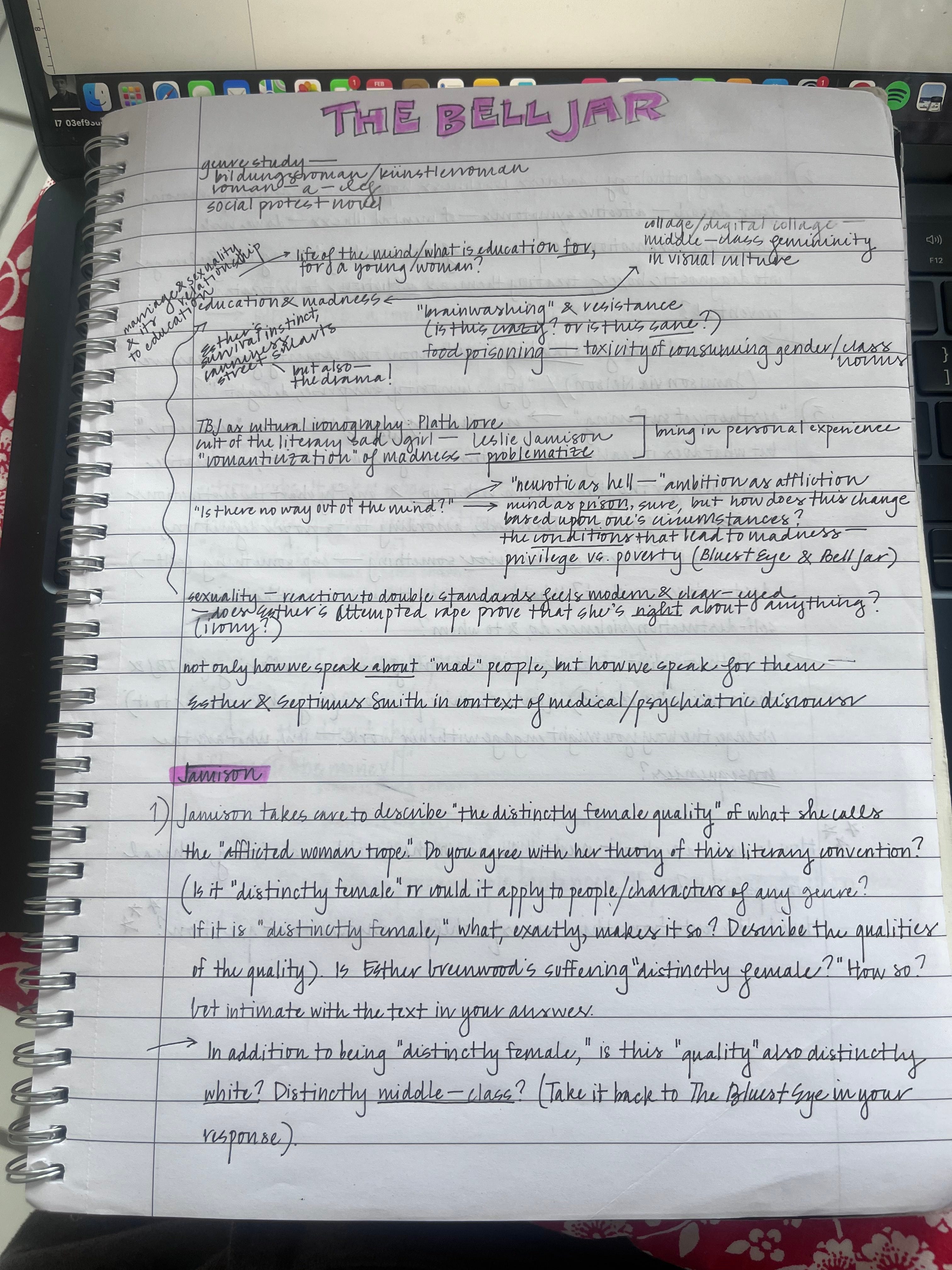
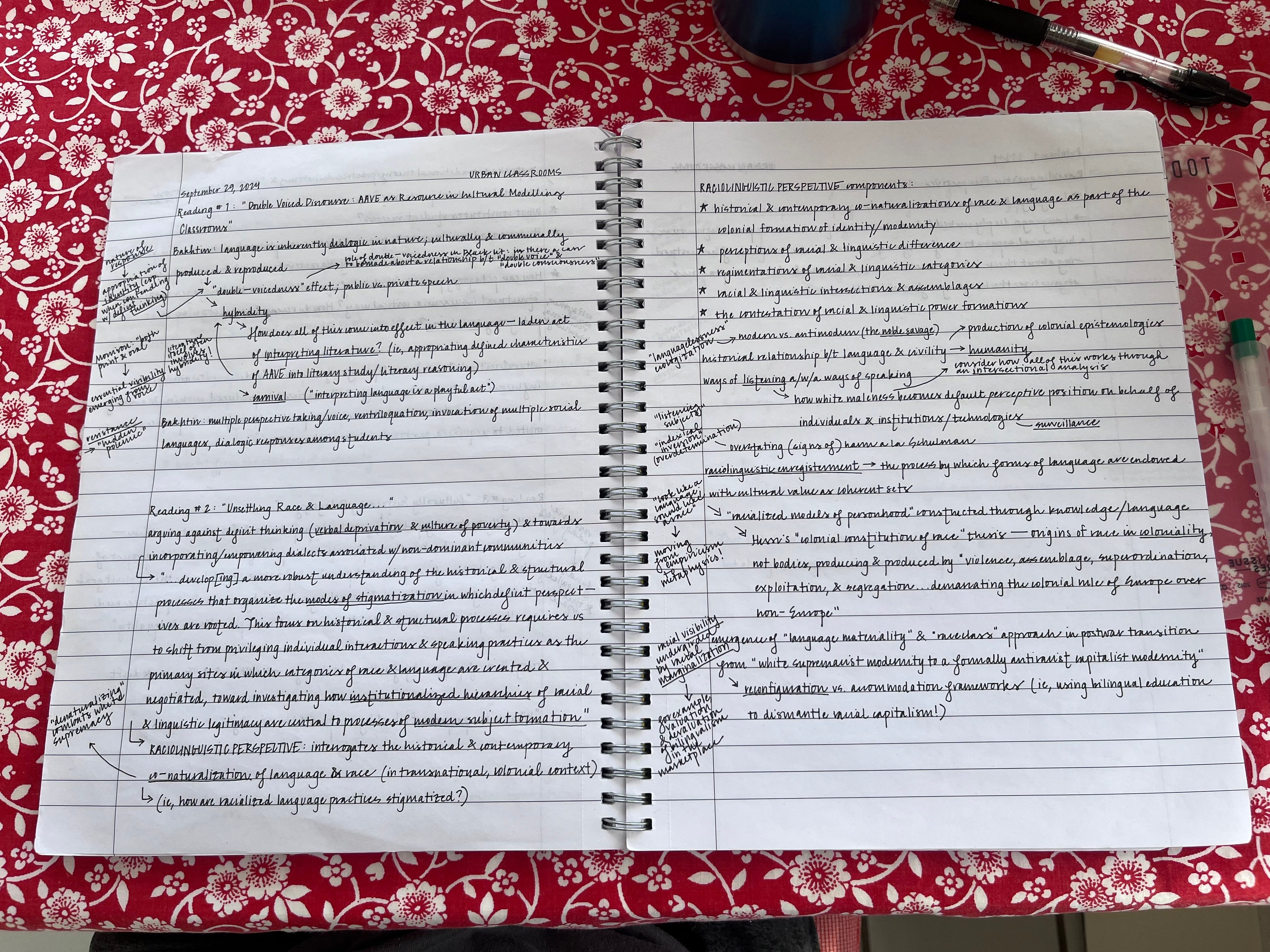
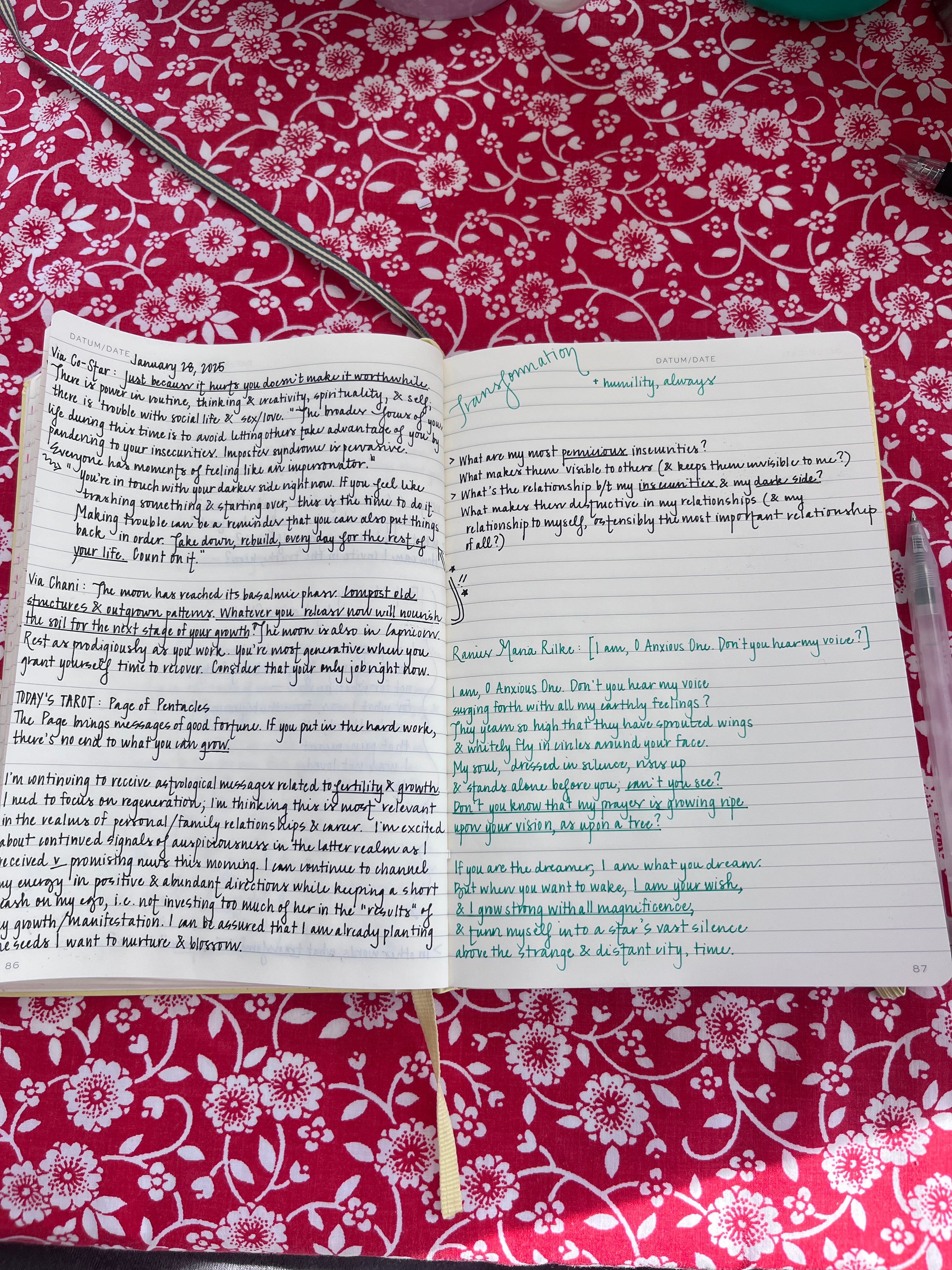
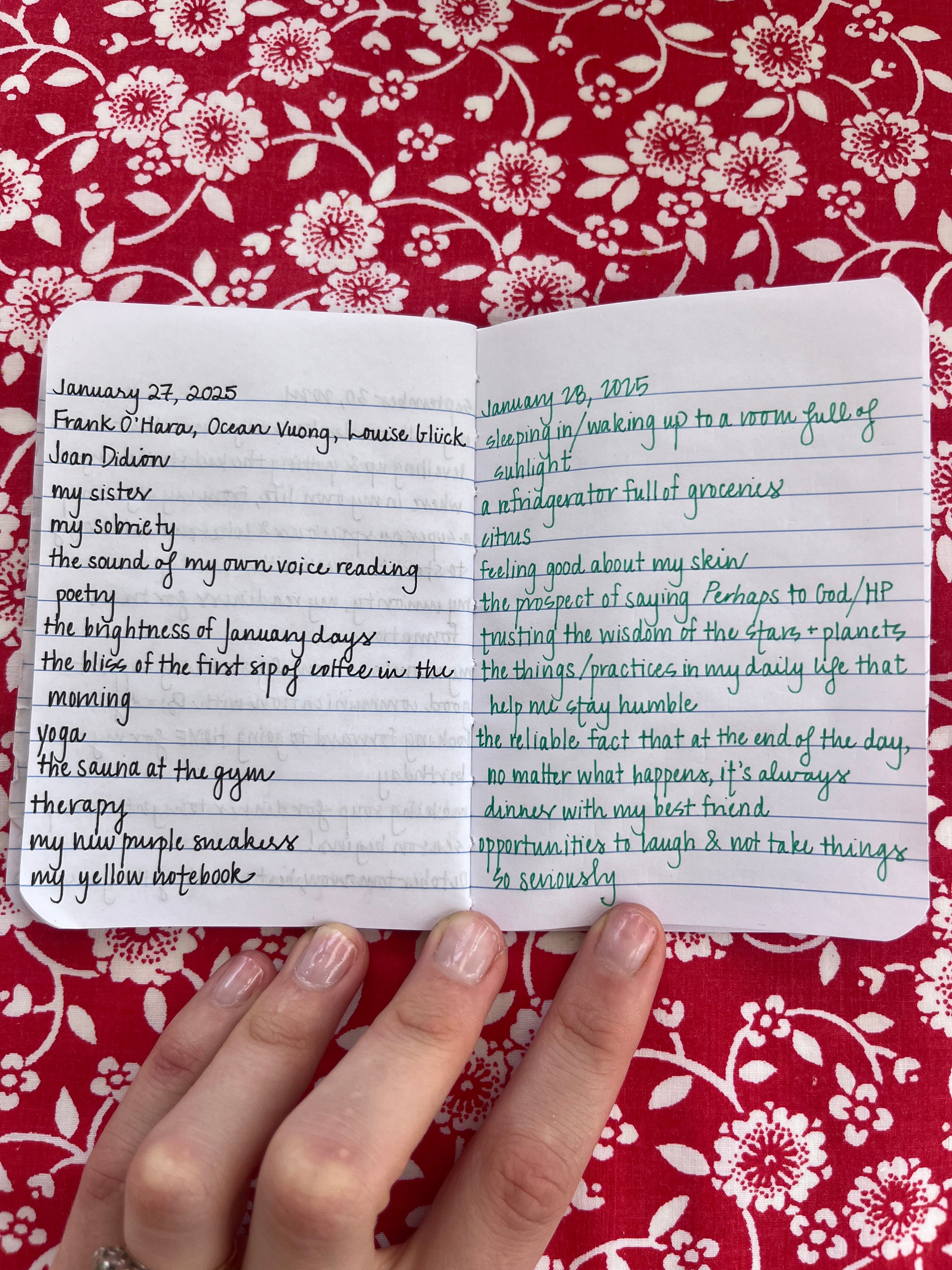
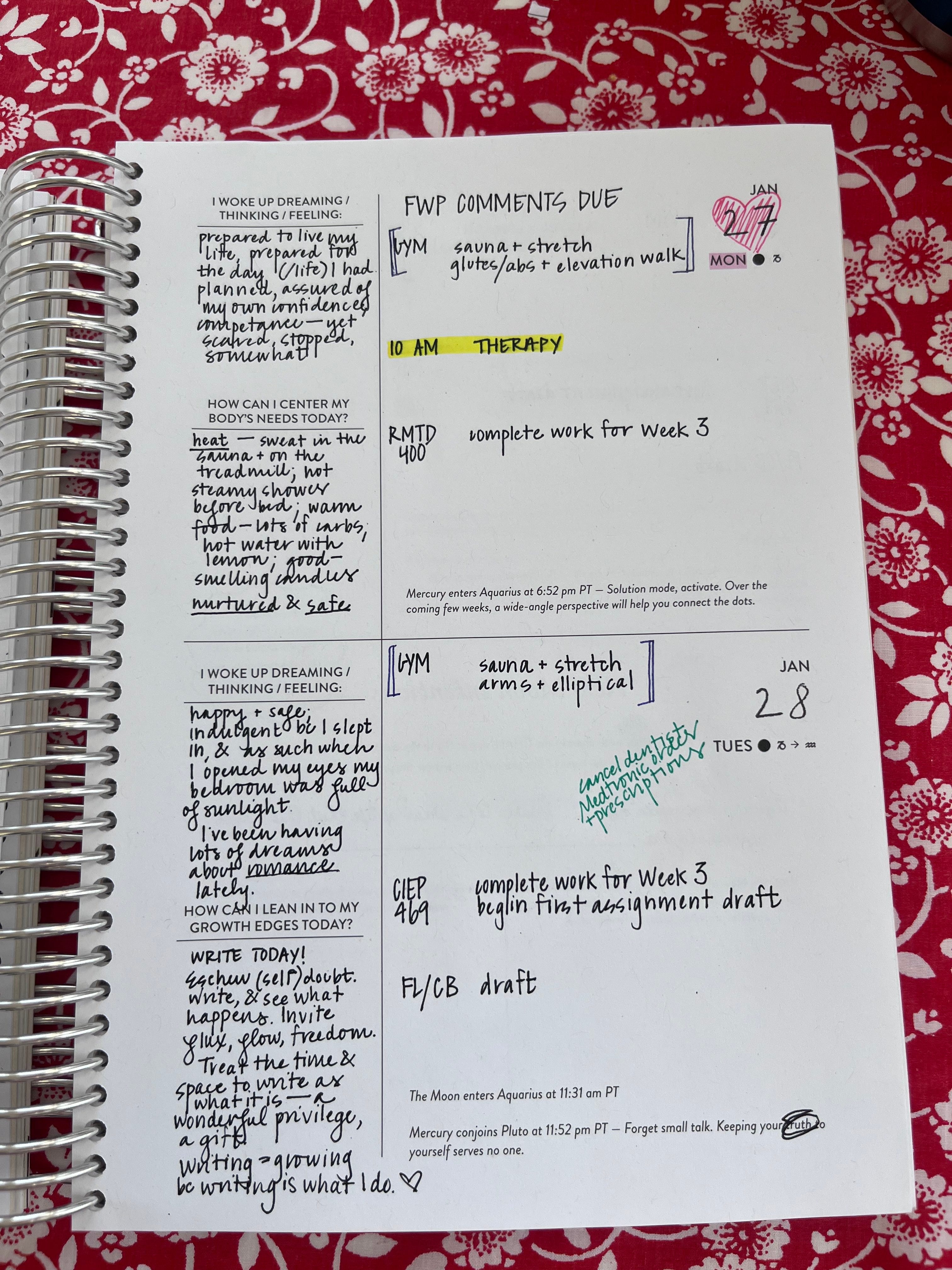
Getting intimate! Take a peek inside my four notebooks.
All in all, I spend a little more than an hour each day updating my four notebooks. “You are doing too much,” you might say to me. And, yes, it’s likely that I am, likely that I am giving my “peculiar compulsion” too long a leash, here. But, as Didion says, the “impulse to write things down” is “inexplicable to those who don’t share it.” In other words––you wouldn’t understand.
Writing things down makes them real, meaningful, consequential for this cerebral, dreamy Libra who has often been accused of spaciness and who has a tough time with logical, linear, and concrete thinking. I believe the science that says that there’s a strong neural link between the hand and the brain, that writing things out mechanically helps you process and code them more effectively. In any case, I repeat some version of this basic concept nearly every week to my highly-wired students who compliment me on my handwriting because they aged out of learning it in school. I do think my kids do better in general when they have a ledger of class notes and annotations scrawled in the margins of their books to draw upon; I also think that taking the time to write by hand––whether in a lecture, in planning a day’s activities, or in reflecting on something personally resonant––is an act of micro-resistance against the accelerated-capitalist optimization economy that promotes digication, simplification, and efficiency at the expense of all else (like, for example, our brains). I understand what people mean when they refer to the “attention economy;” I find that a commitment to the analog and manual is one way to opt out.
That said…
Didion also writes, “Keepers of private notebooks are a different breed…lonely and resistant rearrangers of things, anxious malcontents, children afflicted apparently at birth with some presentiment of loss.” When I apply this insight to myself––well. I smile, tight-lipped, ironic, is what I do.
Remember Didion says that we tell ourselves stories in order to live, and that what she’s talking about is our capacity for self-delusion, self-deceit. The notebook, Didion suggests, is one such story––one such fiction, in fact––that props up our scant, ego-driven perceptions of coherence, control, and meaning in a rigorously disordered world. When I was in high school and college, I sustained my journal as a novelistic personal narrative, describing events, conversations, and ideas in meticulous detail. I treated my journal in those years as an obligation––like homework––as if there was in fact a posterity that I had a responsibility to write toward, as if life itself did not happen until it was dutifully reproduced between the lines. When I got to the last page of a journal I would place it in the boarding-school trunk that now lives in my mother’s basement; occasionally, when I visit home, I’ll take one out and page through it. I wince-cum-smile-warmly when I read my own terminally-earnest profusions on what it felt like to be kissed by that boy or to sit on the New Side of Peirce Hall, the center of my universe, and discuss Judith Butler with my friend Devon.
I know now what I didn’t then: that I was doing this to give shape and nuance and texture and bounce to my life, to give it, in other words, a novelistic bent: a novelist, after all, was what I wanted to be. Or: what I really wanted to be was a character in a novel, an objet d'art, a young woman whose circumstances were dynamic enough to cohere a story around. It wasn’t enough for me just to write the story of my life––the story of a chronically lonely, fatherless post-adolescent girl from Ohio in thrift-store clothing whose serious devotion to the literary was not, though it often came off this way, a pretense or a put-on or an affectation but moreso an oxygen mask, a flotation device––in living it; I had to elevate it by transposing it into words that might legible to somebody else. In a way, I was not only magpie-ing the detritus of my life for the sake of my narrative, I was offering myself up to be sold out. To whom? I don’t know. Myself, I guess––I wanted to sell the younger me out for the older one’s edification. Didion, again:
How it felt to me: that is getting closer to the truth about a notebook…. I imagine that the notebook is about other people. But of course it is not…. Remember what it was to be me: that is always the point ....[H]owever dutifully we record what we see around us, the common denominator of all we see is always, transparently, shamelessly, the implacable “I.”
I remember what it was to be me. I remember what it was to feel so isolated that my only real confidante was myself. I don’t know if I need a journal to remember all that. In fact, I fear, though the twenty-eight-year-old me looks and feels different from the twenty-year-old one, that I am but a matryoshka doll, or the narrator of Sandra Cisneros’s indelible short-story “Eleven,” that twenty is inside of twenty-eight in a way that makes twenty visible to twenty-eight’s interlocutors but perhaps not to twenty-eight herself. “I think we are well advised to keep on nodding terms with the people we used to be, whether we find them attractive or not,” Didion says. “We forget all too soon the things we thought we would never forget. We forget the loves and the betrayals alike, forget what we whispered and what we screamed, forget who we were.” As much as I might like to forget, the softest and scaredest parts of me, the innermost matryoshka or innermost girl on her eleventh birthday, can’t or won’t.
But back to the ethics question. In the end, does such a probing awareness of myself––the self that I wear out the door these days, or the self that I was a dozen years ago––always make me better? Make me a better person, partner, daughter, sister, friend, educator, writer, researcher? In a me-first, myopic, atomized and isolated culture in the grips of the most reductive and pernicious identity politics, should I continue the daily practices of reflection and recording that keep at the center the “transparently, shamelessly…implacable ‘I’”? In so doing, am I continuing to make myself into an object for my own consumption? Would it be better to turn away? Turn to others? Eschew and efface the self that appears, throughout the years, in my many notebooks’ pages? Like Didion, like my parents, I suspect I am made this way, made to be a chronicler and a magpie. But at what cost do I register, introspect? At what cost, I mean, to myself, and to those I would be in community with? Is there any other way to be, for me? Should there be? Or is the story of the notebook––both why I keep it and what it contains––just another story of self-deceit, another story I tell myself in order to live?
In what ways might our collective use of social media––social media being, at its origin and to some extent in its contemporary utility, a sort of journal––be subject to a similar interrogation? (See Jia Tolentino’s sobering 2020 essay “The I in Internet” for help with this).
To touch briefly upon my last newsletter, as well as upon a vital imperative to being-a-person-in-this-forsaken-timeline–– in what ways might keeping a notebook help me spend better, more altruistic time with the world? In what ways might it not––in other words, what turning away from the world am I doing in the notebooks I keep?
In what ways might Didion’s positionality––to use a graduate-degree-in-education buzzword––as a privileged, even spoiled, white mid-century post-ingénue both illuminate and obscure her analysis here? What stories, in other words, is she both telling and not-telling herself, with respect to her notebook-keeping, in order to live? What makes these stories relevant to me? In other way of looking at it, how does both what I might share with Didion as far as identity goes, as well as what I don’t share with her, shape how I read and put myself in conversation with here, here?
Other Things For Learners:
On Friday I spent the day at my favorite place, the Art Institute of Chicago. Because I am lucky enough to visit this world-class museum several times a year––often with loved ones in town––I try, when I have the opportunity to go to the museum solo, to spend the most time with artworks I’ve never seen before, since the tourist trip usually takes you through the Miniature Rooms, the major Impressionists, and the American Art collection on the second floor. This time, I pored over the baskets of the Passamaquoddy master weaver Jeremy Frey. I walked into his exhibition in the Textiles rooms in the corner of the basement almost by accident, and walked out completely transfixed. The baskets themselves are stunning; the video on his process––which involves felling Maine ash trees, dragging them out of the woods, stripping them, flattening them, breaking them down into requisite shapes and pieces, hand-dyeing them, using a lathe to make basket molds out of them, and finally weaving them into the final form of an exquisite vessel all on his own––was especially fascinating. (You can find similar videos here). A sizable crowd of museum-goers stood watching the video, projected onto an exhibition-hall wall; we shared audible gasps, “my Gods,” and “wows;” I made eye contact numerous times with the people around me. It was a wonderful experience of collective focus and gratitude in what is usually a rather insular experience. It was a gift––a beautiful parcel of time spent with the world. (Even though it was a rainy day in the basement of a massive art museum in a busy city, it felt like spending time with nature, too––and as such it was doubly blessed).
Elsewhere in the museum I dove into the staggering Project a Black Planet: The Art and Culture of Panafrica temporary exhibition. This was just as much an anthropological, cultural, and historical presentation as it was an artistic one: my favorite features were Ebony G. Patterson’s Bling Memories––coffin-shaped sculptures bedecked with crochet doilies, fabric appliques, fabric flowers, fringe, glitter, lace, rhinestones, ribbon, tassels, and more––and Kawira Mwirichia’s series of kanga flags, To Revolutionary Type Love; I spent the most time with the the extensive display of books, magazines, records, political pamphlets, photography, and ephemera which have helped circulate ideas of resistance and self-invention worldwide since the early 20th century. The exhibition is organized around the philosophies of Garveyism, Négritude, and Quilombismo, and beyond feeling fascinated and invigorated by the art, culture, history, and context I was bearing witness to, I also experienced a powerful frustration that such a history of global Black collectivist liberatory politics has been obscured from me throughout my (top-of-the-line, as far as these things go) education. When I got home and tried to explain the exhibit to Brady, I said something like, “I can’t believe I took AP US History and my teachers thought it was essential that I knew all about Boss Tweed and Tammany Hall and I never heard anything about the Ten-Point Program.” Obviously I know why Black Power as a transnational, transhistorical movement isn’t discussed in American schools, but it still pisses me off, and now I want to learn more. To that end: anyone have any particularly comprehensive book, documentary, or podcast recommendations on this topic?
A final note on my trip to the AIC: I don’t really know why the idea compelled me, but I decided to listen to a combination of Miles Davis and John Coltrane records as I walked through the museum on my own. In a self-aware way I was trying to elevate my high-culture experience, but I also found it tremendously stimulating, a great means of staying focused on the artworks and my intellectual reactions to them. Brady’s cool musician sister, Abby, told me she often listens to Steve Reich’s minimalist compositions in art museums; I recommend finding the non-lyrical musician(s) that most excite you and taking them on a date to the museum of your choice.
I finished listening to Lili Anolik’s Didion and Babitz, as well as reading Didion’s dark nonfiction Miami and Babitz’s bubbly autofiction Eve’s Hollywood this week. Expect to read more about these two authors––and what they have to tell us about the cult of the white literary it-girl––in my next Newsletter.
On my desk this week: Caitlin Flanagan on elite schools in The Atlantic; my idol Hanif Abdurraqib’s latest, “Lessons for the End of the World;” Baldwin’s novel Another Country, complemented by the audiobook version of Eddie Glaude’s sort-of Baldwin bio Begin Again––a book I should have read years ago; all the news I got behind on while I was resisting reality via my Didion & Babitz binges.
Finally, if you’ve read this far, I thank you. I also ask you for a favor: if you liked any aspect of this newsletter, would you mind passing it along to a friend or two? I’m excited by the ways in which my FOR LEARNERS/CURIOUS BEINGS readership is growing, and I’d love to be able to connect with even more people through my writing.
Part of the “compulsive notebook keeper” club for many many years now. Lonely in my own thoughts at times, but not lonely in this (obsessive?) search for nuance via journaling. Felt very seen- Love this piece Char! 💗